|
Liberals on defensive after magazine
calls Martin "Mr. Dithers"
by Romeo St. Martin
[PoliticsWatch Updated 6:30 p.m. February 18, 2005]
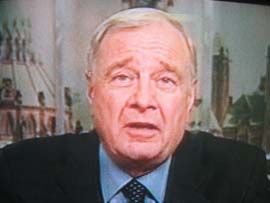 |
| The Economist calls Paul Martin a ditherer. |
OTTAWA —Liberal cabinet ministers say the influential magazine
The Economist got it all wrong when they called Prime Minister Paul Martin "Mr. Dithers" in
a critical article that appeared on the Web on Thursday.
"Even those who are prestigious are prone to error," said Immigration Minister and long-time Martin backer Joe Volpe.
"I prefer to look at the prime minister as someone who is decisive and has a very firm view of where he wants to take the country."
In a story headlined "'Mr. Dithers' and his distracting 'fiscal cafeteria'," the magazine offers a critical assessment of the PM's performance so far.
"But 15 months after succeeding his fellow-Liberal, Jean Chrétien, Mr. Martin, a successful finance minister for almost a decade until 2002, cannot quite shake off the impression that Canada's top job is too big for him," the magazine says.
"As finance minister, Mr. Martin acquired a reputation as a tough and decisive deficit-cutter who transformed the public finances and oversaw the renaissance of the Canadian economy. But as prime minister, his faltering leadership has earned him the sobriquet of 'Mr. Dithers'."
In the past, Liberals pointed to an Economist feature praising Canada as being "cool" for marijuana decriminalization and same-sex marriage legislation.
But after question period Friday, Liberals viewed The Economist as just another magazine and
denied that its portrayal of Martin as a man who tries to please everyone and is slow to make a decision is damaging to Canada's reputation abroad, a reputation Martin has gone to great lengths and travels to improve.
"I think The Economist got it all wrong," said Volpe, who cited the PM's health-care deal with the provinces.
"He's putting in place policies and programs that are good for the benefit of the country and
its citizens - and that's not dithering."
However, The Economist article was critical of the
health-care deal with the premiers.
"The provincial premiers, who run the system, subsequently extracted from Mr. Martin a larger cheque than he had originally offered: $41 billion over ten years, as well as a special deal for Quebec. He failed to win any commitments to reform the system in return," the magazine argued.
Finance Minister Ralph Goodale called The Economist article "a magazine article by some particular journalist" with a point of view.
"Don't get hung up on one journalist with one view," he said.
"We've got the best fiscal situation in the G-7. We are a country where
the line ups for immigrants
who want to come to our shores is absolutely overwhelming. That's a vote of confidence
in the greatness of Canada."
But opposition politicians believe The Economist has not only done damage to Martin, but
to Canada's global reputation.
"I think it hurts our international reputation," said Conservative MP Monte Solberg.
Solberg said the "Mr. Dithers" label goes well with Martin and his reputation for putting off decisions.
"If the shoe fits …" he said. "If he wasn't a dither, we couldn't call him a ditherer and be credible. But he is ditherer and so it's in fact a name that's going to stick with him."
NDP MP Ed Broadbent, who described himself as a regular reader of The
Economist, agreed with the article's assessment of the PM.
"I think two things are seen about Mr. Martin: One, he is a reasonable, nice congenial guy. Most Canadians think that. Anyone who talks to him thinks that. Point two, is that he can't make up his mind and he doesn't make up his mind, at least on tough questions. He continues to talk around them, instead of taking decisive
action."
Broadbent pointed to Martin's special equalization deals with Newfoundland and Nova Scotia that were mentioned in
the "Mr. Dithers" article and said this is an example where Martin's dithering and trying to please all is doing great harm to national unity.
Since the deals with the two provinces, Ontario and Saskatchewan have also asked for their own equalization deals.
"This making a decision to please someone very much in the short run without thinking two steps down the road is causing real problems, real problems in governance of the country and real problems therefore also in a national unity sense because people on a regional basis get
upset," Broadbent said.
Broadbent said he expects Martin's inner circle will likely view the
The Economist's review as an issue that has to be dealt with.
"My own view about that is that the prime minister of Canada or, indeed, the president of any other state should tell
The Economist to get lost. They shouldn't be concerned about it.
"But this government - more than most in recent memory - has been concerned about the image as opposed to substance and they probably will respond and think, 'My goodness what will we do?'"
© PoliticsWatch® 2005. All rights reserved. Republication
or redistribution of PoliticsWatch content, including by framing,
copying, linking or similar means, is expressly prohibited without
the prior written consent of Public Interests Research and Communications
Inc. (PIRCINC). PoliticsWatch is registered trademark of PIRCINC. |